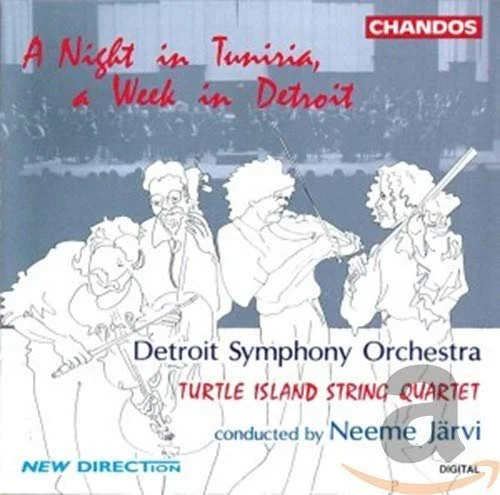
Interchange
1994
Jazz String Quartet
Instrumentation: 2(pic:afl).1+ca.2(bcl).2/4.3.2.1/4perc/str
Program Notes
When two freeways meet at an interchange they do not literally intersect, rather they preserve their independent motion, sharing the same space for a bit of distance. I’ve always strived for a synthesis in my work that does not compromise the integrity of the musical forms or styles being combined. Interchange is not about a blending of styles, but rather a musical conversation between two very rich traditions.
My most concrete musical image came from my days of writing music for big band, where the saxophone section often plays the role of a group within the group. Because of the saxophone’s agility, one often writes a “sax soli” section, which is entirely composed and harmonized, but still has a soloistic quality. My idea was to use the string quartet not only as soloists, but also as the “sax section” of the orchestra. À There is the precedent for this practice in western music when a “ritornello” group functions as soloists within the larger ensemble (Bach’s Brandenburg concerti, for example.)
The quartet begins as a group, with no improvisation in the 1st movt. The 2nd movement opens with short solo phrases over the muted string orchestra, ending in a group improvisation as the orchestra fades away. This leads into the solo quartet movt. (I Solisti) which is immediately answered by the 4th (Tutti). By this 4th movt., the quartet’s role has shifted largely to that of improvisation.
The beginning of the 4th movt. is an especially relevant moment for me in this dialogue of soloists and orchestra. The image I got was that of the orchestra wanting to jump in and take a solo of their own, so inspired b|y the energy of the quartet, (although their response was written more like Prokofiev than James Brown.) This movement is the culmination of the interchange, as the orchestra serves as the big band “shout chorus” with the quartet. The orchestra eventually fades into the background, becoming in effect the jazz rhythm section for the quartet’s final improvisations.
– Jeff Beal