Four Score
2025
Orchestra
Instrumentation: 2,picc,cl,b.c.,2(c.b.)/3,3,2,1/2,timp/pn/strings
22:00 min
Available for purchase here.
Program Notes
In 2023, I learned the esteemed American conductor Leonard Slatkin would be soon be celebrating his 80th birthday. Feeling grateful for his artistry as a conductor, and his championing of many of my own concert works well into his 70s, I proposed to Leonard a new composition - something in honor of this 80 year milestone. Thankfully he accepted, and my work on Four Score began.
Leonard's musical life and childhood began in Los Angeles. His parents, Eleanor Aller and Felix Slatkin were the founding members of the Hollywood String Quartet, as well as the principal cellist and concertmaster at Warner Brothers and Fox studios respectively. Being an artist whose life and work also intersects Hollywood, I proposed to Leonard a symphony, which in some way, might celebrate the shared roots and connections we have to Los Angeles. As I was just getting started, I happened to discover a wonderful book by another esteemed conductor, John Mauceri. In "The War on Music" Mauceri brilliantly describes an odd musical rift which occurred in the 20th century - After WW II, music was divided into camps of serialism and "everything else.” which wasn't considered legitimate art music.
"Everything else" included most prominently the musicof Wagner, Strauss, and late Romanticism - especially anything approximating tonal harmony or a singable melody.
"The War on Music" continues to describe a key diaspora of jewish composers who were fleeing the pograms coming horrors in Germany. Some of them, such as Max Steiner, Wolfgang Korngold and Alfred Newman found themselves in Los Angeles, creating music for a new art form that was beginning to include recorded music - Hollywood cinema. Ironically, this out of favor musical language was exactly what they found useful in creating music for Hollywood.
I've never really liked or understood silos in art. I consider myself free, even fortunate to have composed for both the screen & concert stage. This is becoming more and more "normal" in 2025. However, there still there seem to be some rules - some unspoken artistic lines one must not cross if one is to be taken seriously. I thought to myself, "what would a concert piece where I feel free, even perhaps emboldened to use some of the musical language I have employed in my 30 years writing for the screen sound like?" In fact, the theme I had already decided for Leonard's symphony kind of demanded it from me.
Thus, the movements of Four Score are musical studies of three narrative archetypes - some often used in film music, expanded into a symphonic form.
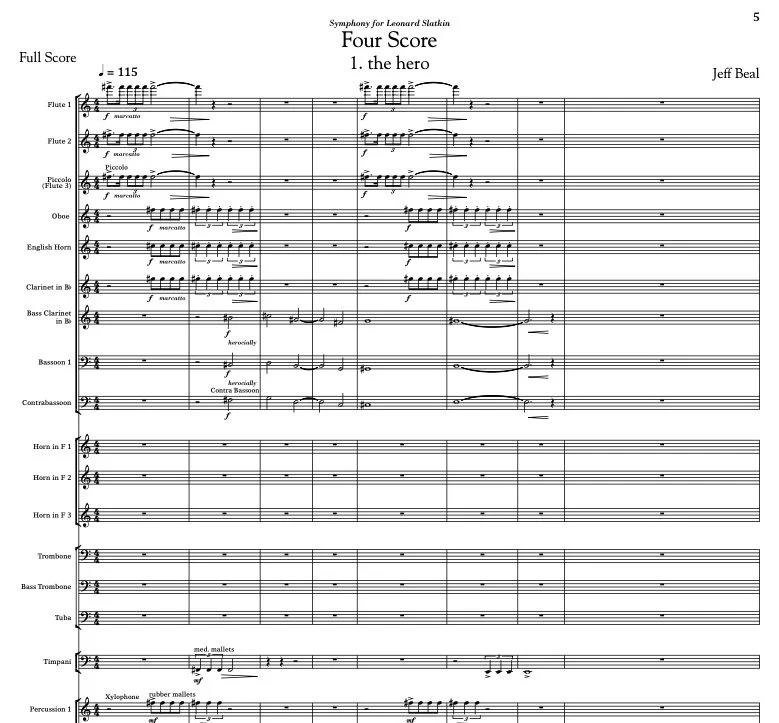
"The Hero" channels a bit of the bravura of John William's and Jerry Goldsmith's rich heroic and adventure scores. It isintended to inspire and thrill.
"The Lovers" explores the theme of romance and longing. This movement begins with solos for the first violin and cello, a direct nod to Slatkin's parents Eleanor and Felix.
Finally "The Jester" explores comedy, surprise, and laughter. As a young film composer in 2000 I won my first Prime Time Emmy scoring Tony Shaloub's brilliant portrayal of a detective with OCD - Adrian Monk. Through the eight seasons of composing for over a hundred episodes of MONK, I learned just how how meticulous and inventive the art of comedic timing can be in the hands of a master such as Shaloub.
Leonard's uncle, Victor Aller was the pianist at Warner's, and his piano teacher. Throughout the symphony I used piano -something I've rarely done in my orchestral works. It felt like another appropriate nod to frequent use of it in my film scores - most importantly a nod to a final piece of Slatkin's's rich musical heritage.
As I was finishing the final orchestration of "The Jester" I thought of a work I studied in high school in great detail - Stravinsky's ballet Petrouchka. These early ballets were a crucial early influence and obsession of mine. Today, still remain enamored of Stravinsky's rich orchestration, narrative genius, and complex harmonic and melodic language. It was no coincidence that Walt Disney appreciated his genius, and featured Stravinsky 's music in his animated film Fantasia.
"The Jester" careens through mazes of syncopation, surpise and counterpoint, and finally pivots - Four Score ends with a joyous coda in a 7 meter. This shift also felt appropriate for my chosen theme - a celebration of 80 years of life long music making, dear friends, and good health. Hollywood likes happy endings. Happy birthday maestro!
– Jeff Beal
New York City July 2025